Collin Stockmoe

Hometown: Dallas, TX
Email: cmstockm@ncsu.edu & collinstockmoe@gmail.com
Bio
Collin Stockmoe is a senior at the Wilson College of Textiles studying Fashion/Textile Management with a concentration in Product Development. Originally from Dallas, Texas, he began his unconventional path into fashion young: buying, collecting, and reselling vintage and designer clothing. From handling and taking apart garments that have survived, he gained an inside-out understanding of what makes a piece substantial. Driven by fashion history, Collin has a strong appreciation for the designers and work that came before him. As a student, Collin is a true product developer at heart; detail-oriented and driven by a passion for understanding garments inside and out. Outside of the studio, Collin has a wide range of passions, including music, basketball, and a deep love for his two cats, Goose & Mila. Graduating in Spring 2027, Collin hopes to build a career in New York in product development/technical design.
Collection Concept
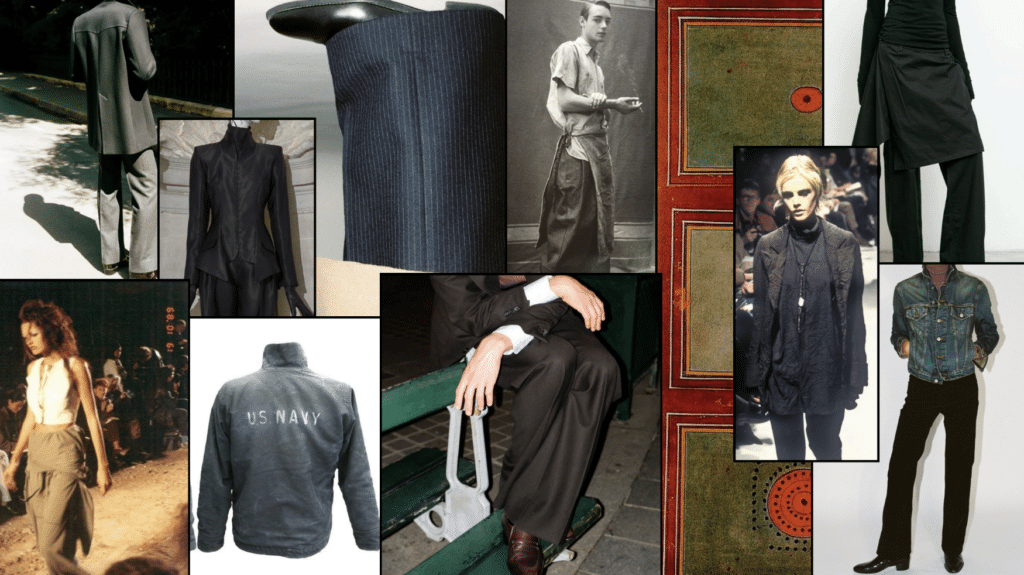
Meridian is built around a single idea: balance isn’t a compromise; it’s a line where two opposing forces meet and hold each other steady. Modern life is built for ease; everything moves faster, cleaner, more precise, until the process behind it disappears completely. But it’s the process, the balance, the imperfection, that makes something feel real rather than manufactured. Meridian explores that tension, emphasizing the contrast and allowing the space between these forces to feel like comfort rather than discomfort. That tension shapes how the collection is constructed: masculine & feminine, precision & wear, rigid & soft, military & romance.
As a design language, Meridian redefines vintage & contemporary design, emphasizing material and silhouette stories. Soft tailoring and rigid workwear are reinterpreted while respecting the garments and construction that have survived decades. Utilitarian edges and a lack of ornamentation drive the focus on necessity & restraint, only pushing forward what is needed. Heavily influenced by the surge of minimalism that emerged in the 1990s after years of 1980s glamour, the lack of excess makes every design choice conscious and thoughtful.