Olivia Kollin

Hometown: Long Beach, CA
Email: ojkollin@ncsu.edu & oliviakollin@gmail.com
Bio
Olivia Kollin is an emerging fashion designer who focuses on the connection between art, storytelling, experimentation, and self-expression. As a Fashion and Textile Management student at NC State University with a concentration in Fashion Development and Product Management, she has developed expertise in garment production, pattern-making, textile design, CAD, and 3D apparel visualization. Currently in her 7th semester as a stylist for Platform Magazine, she has explored and deepened her passion for a garment’s visual storytelling.
Olivia’s passion lies in exploring unconventional beauty and soft elegance, juxtaposing imperfect humanity with the macabre. Her approach is characterized by unconventionality, experimentation, and intuition. She enjoys the freedom to explore how inspiration, materials, and process help shape expressive silhouettes, unique fabrics, historical references, and the individuality of garments.
Collection Concept
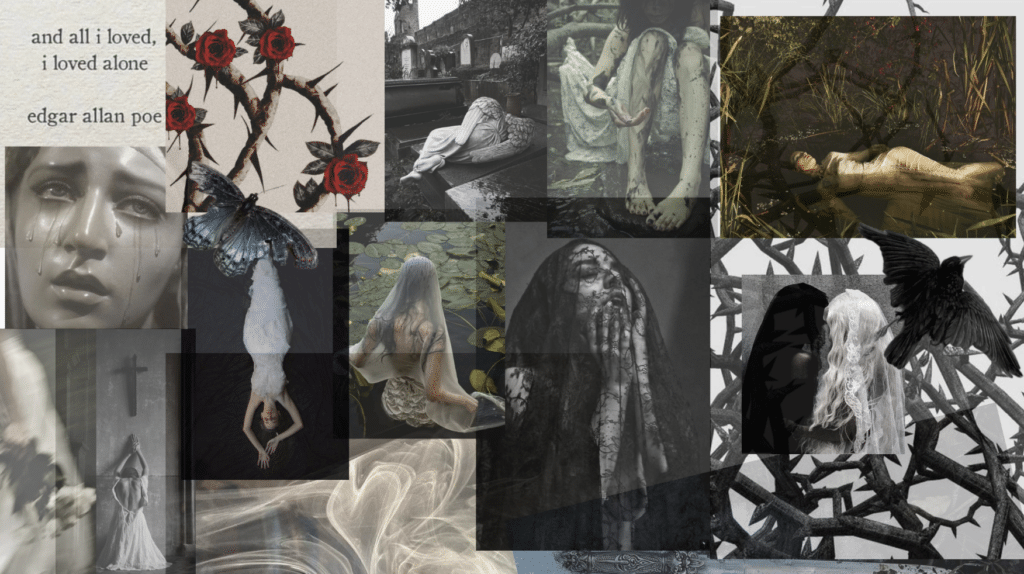
and then it’s gone explores the feeling of losing something significant and learning to exist within the absence it leaves behind. Whether it’s a loss of life, love, inspiration, feeling, or self, it reflects grief that never entirely disappears but transforms, lingering quietly within what remains. The collection draws heavily from the deep spiritual weight of Florence, Italy, where centuries of ancient beauty exist alongside histories of love, death, devotion, and change. Within its cobblestone streets, churches, art, and architecture, a vivid sense of what has come and gone yet somehow remains eerily present. This coexistence of absence and presence serves as a broken mirror between two entirely different worlds. This idea is further explored through the goddess of crossroads, transformation, and liminal spaces, whose presence within the collection reflects what is no longer here and the blankness of what is to come. Juxtaposition carries this tension into the garments, progressing through stages filled with hope and beauty that slowly turn into something raw and unspoken, to a final end all be all. Lightness gives way to darkness, delicacy to decay, yet neither seems to completely fade; and then it’s gone, moving through numbness and mourning, memory and transformation, asking how something can be gone, yet endlessly linger around.